
Why Green Chemistry is the Future of Cleaning


If you’ve ever flipped over a cleaning product and wondered what all those ingredients actually do — you’re not alone. The truth is, most conventional formulas were never designed with human health or environmental impact as the priority. They were built for performance and cost, with everything else treated to meet the minimal legal requirements or even as an afterthought.
Green chemistry flips that approach entirely.
At its core, green chemistry is about designing products and processes that reduce or eliminate harmful substances from the start. It’s not about making something “less bad.” It’s about building something better from the ground up, inspired by how nature cleans, well, naturally.

Why Green Chemistry Needs to Start in the Classroom
If green chemistry is going to shape the future of cleaning — and chemistry more broadly — it can’t just live inside forward-thinking brands. It needs to start much earlier.
Today, many chemistry programs still prioritize efficiency, yield, and performance above all else. What’s often missing is a required framework for understanding the environmental and human health impacts of the materials being developed. Chemists are trained to solve for function, but not always for consequence.
Every formula that gets created doesn’t exist in a vacuum. It moves through homes, waterways, and ecosystems. It interacts with human bodies over time. Without that context, it’s easy for harmful chemistries to be scaled simply because they work well at the moment.
Green chemistry changes the lens. It teaches chemists to think beyond immediate performance and consider the full lifecycle of what they’re creating — from sourcing to use to what happens after it leaves the drain.
Making green chemistry a standard part of scientific education ensures that the next generation of chemists understands the weight of their work. It creates a baseline expectation that performance and responsibility should go hand in hand, not compete with each other.
Why It Matters in Cleaning Products
Cleaning products don’t just disappear after you use them. They move through your home, into your water system, and eventually into the environment.
Traditional formulas often rely on petrochemicals, harsh surfactants, and persistent compounds that can linger long after use. Green chemistry takes a different approach — designing molecules that do their job effectively, then safely break down when they’re no longer needed.
That’s the difference between treating pollution after it happens and preventing it in the first place.

The Problem With “Green” Marketing
Not everything labeled “green” is built on green chemistry.
There’s a big difference between products that are marketed as sustainable and those that are actually engineered to be safer at a molecular level. This is where greenwashing comes in — when brands use vague claims or surface-level swaps to appear environmentally friendly without changing the underlying chemistry.
Green chemistry is harder to do. It requires rethinking formulations from scratch, investing in better ingredients, and prioritizing long-term impact over short-term convenience.

How We Approach Green Chemistry at Dirty Labs
At Dirty Labs, green chemistry isn’t a feature — it’s the foundation of our company.
Every formula starts with the same question: how can we deliver best-in-class performance while minimizing impact on people and the planet?
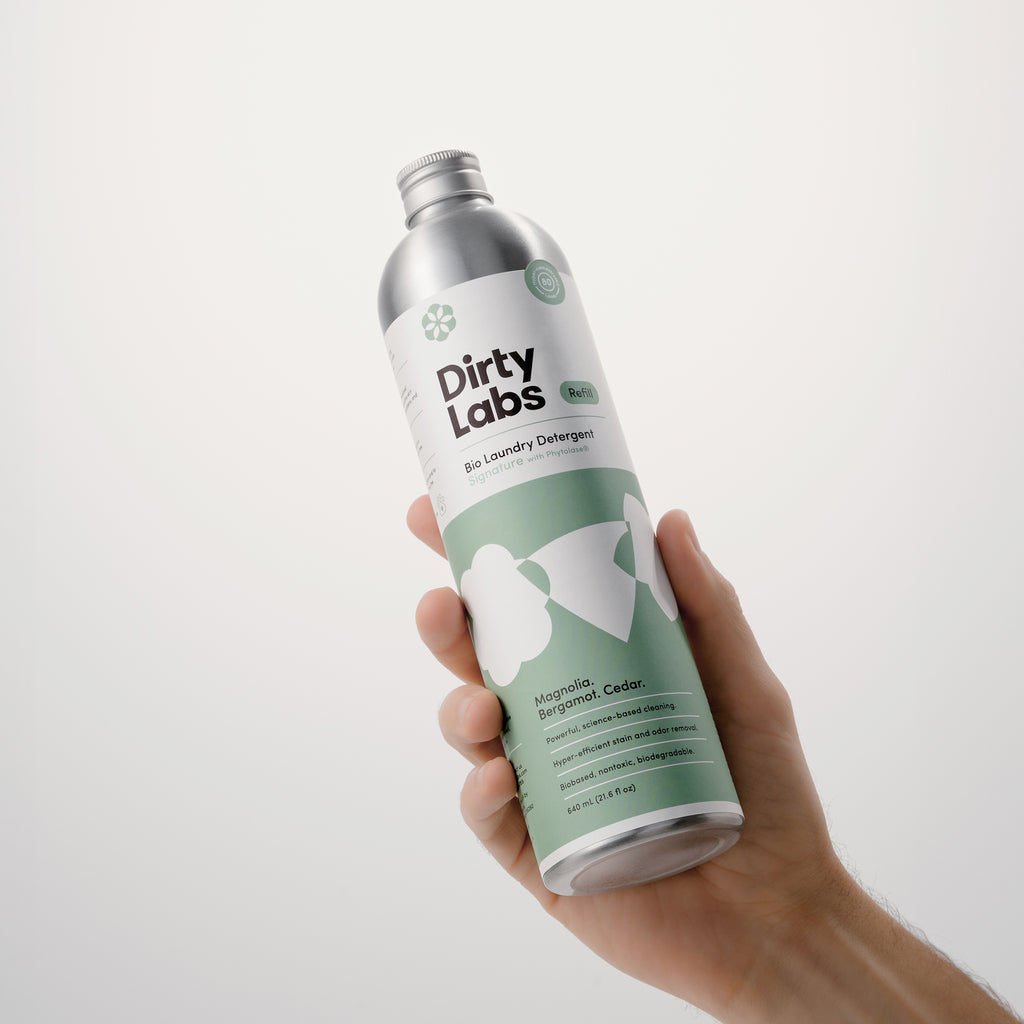
That’s why we use advanced bioenzymes and biobased ingredients that are designed to work with nature, not against it. Our products are formulated based on the most stringent safety criteria, biodegradable, and free from known pollutants — without compromising on performance.
It’s also why we think about the full lifecycle of a product, from ingredient sourcing to packaging to what happens after it’s used.
The Future of Cleaning Is Smarter Chemistry
Green chemistry isn’t a trend — it’s where the entire industry is headed.
As more people start to question what’s in their products and where those ingredients end up, the demand for transparency and better formulation will only grow. And rightly so.
The next generation of cleaning products won’t just be effective. They’ll be thoughtfully designed at every level, down to the molecular structure. And we’re leading the way.




Read more


10/05/26 Home & Laundry Tips & Tricks
How Much Laundry Detergent Do You Really Need? Why More Isn’t Always Better
If you’ve ever looked at a small dose of laundry detergent and wondered, Is that really enough t...


09/21/26 Home & Laundry Tips & Tricks
College Laundry 101: How to Do Laundry for the First Time
Getting settled on campus is an exciting time in anyone's life, but one of the biggest tasks to ...


09/09/26 Safety & Sustainability
Chlorine Bleach-Free Cleaning: Why It's Time to Rethink What "Clean" Really Means
For generations, we've been taught that the strongest-smelling cleaner must be the most effective...