How Much Laundry Detergent Do You Really Need? Why More Isn’t Always Better

How Much Laundry Detergent Do You Really Need? Why More Isn’t Always Better

If you’ve ever looked at a small dose of laundry detergent and wondered, Is that really enough to get my clothes clean? — you’re not alone.

For decades, the laundry industry has reinforced a simple idea: more detergent means cleaner clothes. Bigger loads? Add more. Tough stains? Add more. Not sure? Pour a little extra for good measure.

There’s even an industry phrase for the practice of encouraging consumers to use more product than they may actually need: “dose to delight.” The thinking is that consumers associate a generous dose of detergent with better cleaning performance, so dosing recommendations and detergent caps have historically reflected that expectation.

But the amount of detergent you need isn’t determined by how satisfying a full cap looks. It depends on what’s actually in your washing machine.

At Dirty Labs, our concentrated, bio enzyme laundry detergent is designed to deliver powerful cleaning performance in a small dose. Understanding why starts with three factors: your load size, your washing machine’s capacity, and how dirty your clothes actually are.

What Does “Load Size” Actually Mean?

When detergent brands talk about the number of “loads” in a bottle, they’re working from a standardized load size based on the weight or amount of laundry being washed. That gives the industry a consistent way to calculate dosing and compare how many loads a bottle can clean.

But most of us aren't weighing our dirty laundry before throwing it in the wash. In real life, we tend to judge a load by looking inside the drum — and that's where washing machine capacity comes in.

A medium load in a standard washer might fit comfortably in one machine, while that same amount of clothing could nearly fill a smaller front-loading machine. If the laundry you're trying to wash doesn't comfortably fit while leaving enough room for movement, don't compensate by squeezing everything in and adding more detergent. Split it into two loads instead.

The easiest guideline to remember is what we call the one-third rule: leave roughly one-third of your washing machine drum free. Your clothes need room to move so that water and detergent can circulate through the load and carry soil away. Filling your washer to the brim can actually work against the cleaning process, no matter how much detergent you add. 

So instead of getting out the scale — or breaking out a calculator to determine the cubic footage of your washer — look inside the drum. If your laundry takes up more than about two-thirds of the available space, consider splitting the load.

Match Your Detergent Dose to Your Load — and Your Machine

Once you understand how much laundry you're actually washing, you can choose the right detergent dose.

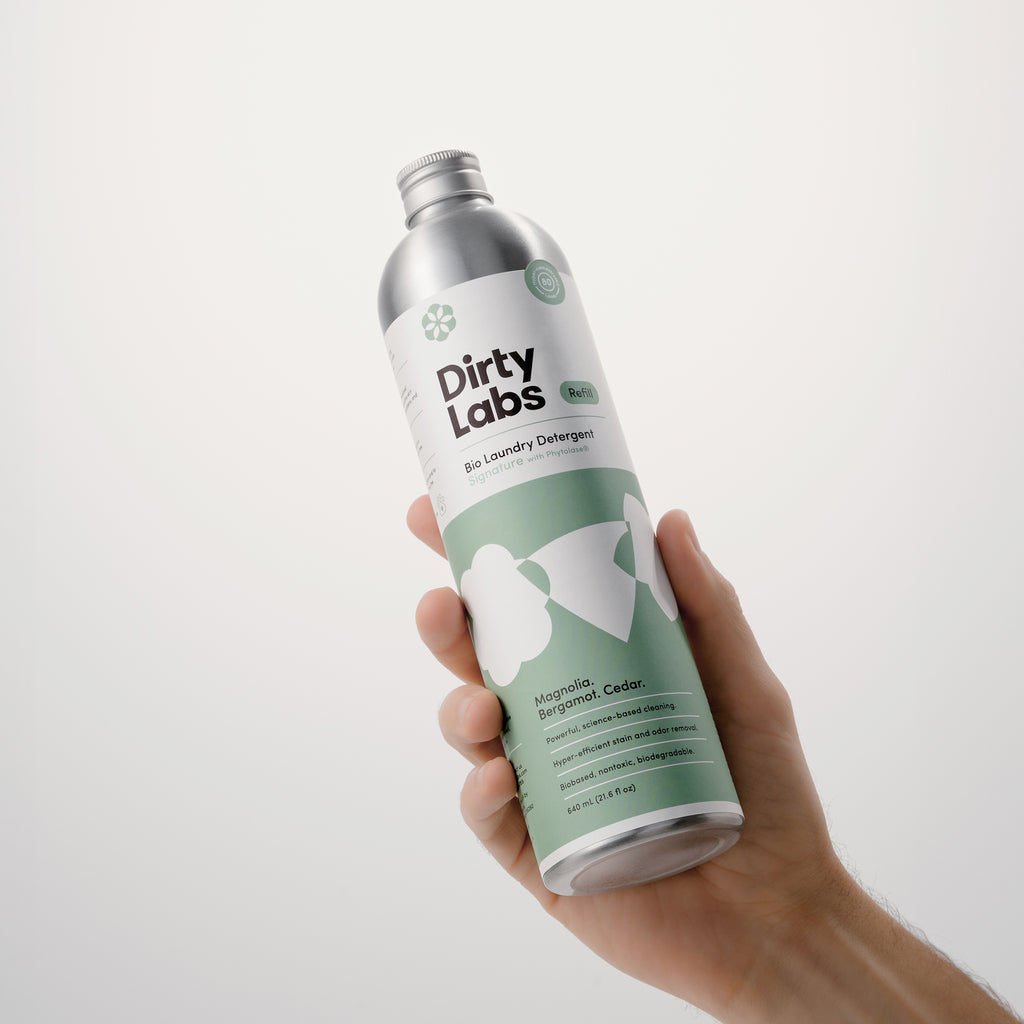
Dirty Labs Bio Enzyme Laundry Detergent is hyper-concentrated, so you don't need a large volume of detergent to clean a typical load. For most washing machines, start with:

• Medium or standard load: 8 mL
• Large or heavily soiled load: 12 ml
 •Extra-large or extremely soiled load: 16 mL

The important thing to match your dose to what you're actually asking your detergent to clean: how much laundry is in the machine, how much room it has to move, and how dirty it is.

How Dirty Are Your Clothes?

Here’s another factor that often gets overlooked: most everyday laundry isn’t actually that dirty.

For many of us, a typical load consists of clothes worn to work, around the house, to run errands, or for relatively low-impact daily activities. They may contain body oils, sweat, food residue, or everyday grime, but they aren’t necessarily heavily soiled.

That means they may not need a heavy detergent dose to get clean.

There are, of course, plenty of exceptions.

If you’re a chef regularly dealing with grease and food stains, a farmer working around soil and mud, a mechanic dealing with oils, or you have another job or hobby that leaves clothing particularly dirty, your laundry has a higher soil level. The same may be true for especially sweaty workout gear, muddy outdoor clothes, or heavily soiled household textiles.

The dirtier the load, the more cleaning power it may require.

Rather than automatically using more detergent for every wash, adjust your dose when the laundry itself calls for it.

When Should You Use More Laundry Detergent?

You may want to increase your detergent dose when:

• You’re washing a larger-than-usual load, particularly in a high-capacity machine.

• Clothing is heavily soiled with dirt, grease, sweat, or other residues.

• Your work routinely exposes your clothing to high levels of soil, as can be the case for chefs, farmers, mechanics, landscapers, and similar professions.

• You’re washing especially dirty items after outdoor activities, sports, or messy projects.

For an ordinary load of everyday clothes, though, more detergent doesn’t automatically equal a better wash.

Can Using Too Much Detergent Make Clothes Less Clean?

It can.

Laundry cleaning depends on the relationship between water, detergent, agitation, rinsing, and the amount and type of soil in the load. Simply increasing one of those variables doesn’t guarantee a cleaner result.

Using more detergent than your load requires can make it harder for your washing machine to rinse everything away completely. And if clothes are packed too tightly into the drum, detergent and water may not circulate effectively in the first place.

Instead of “How much detergent can I add?” we should be asking, “How much detergent does this load actually need?”

Why Does Dirty Labs Use Such a Small Dose?

Dirty Labs Bio Enzyme Laundry Detergent is hyper-concentrated, which means a small volume contains the cleaning ingredients needed to tackle an everyday load.

Our formula uses Phytolase®, Dirty Labs’ proprietary bio enzyme cleaning technology, to target different types of stains and soils. Rather than relying on a large volume of detergent to signal cleaning power, the formula is designed around the ingredients doing the work.

Think of it this way: the size of the dose doesn’t tell you how effective a detergent is. Its concentration and formulation do.

A concentrated detergent and a less-concentrated detergent can require very different volumes of product to clean the same amount of laundry. Comparing them cap-for-cap — or ounce-for-ounce — doesn’t tell you much about how clean your clothes will get.

More Detergent Doesn’t Mean Cleaner Laundry

We’ve been conditioned to see a big pour of detergent as reassurance. More product feels like it should mean more cleaning. But laundry doesn’t work that way.

The right detergent dose depends on three things: how much laundry you’re washing, how much your machine can hold, and how dirty your clothes are.

For most everyday laundry, you may need much less detergent than you think — especially when you’re using a highly concentrated formula designed to work at a smaller dose.

So before you add another splash “just to be safe,” take a look at the load itself.

Sometimes, less really is more.